

WaterSense Certification
Water-efficient homes designed to save water, energy, and money
RunBrook helps builders, developers, owners, and project teams pursue WaterSense certification with practical guidance, documentation support, verification coordination, and building performance expertise.
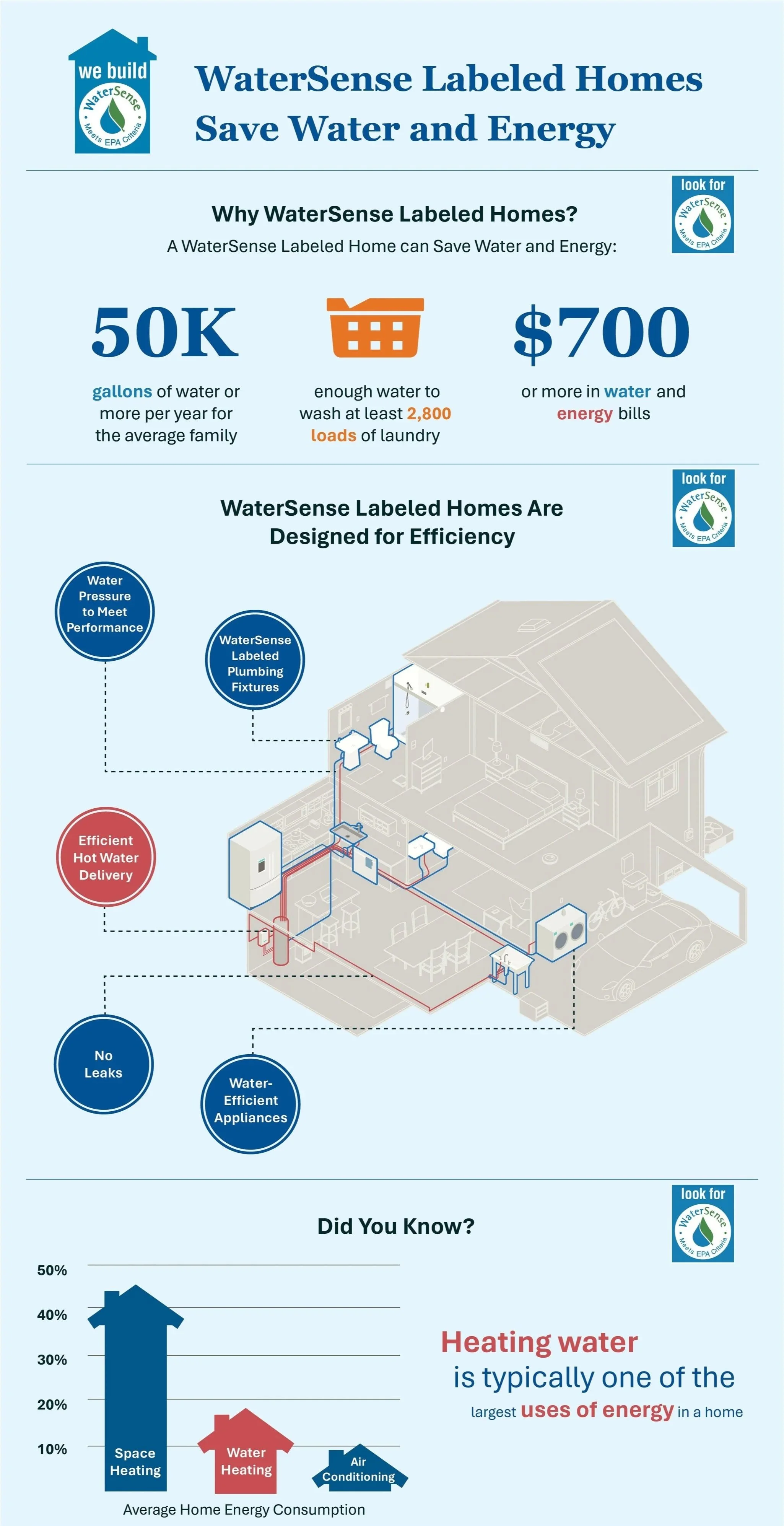
WaterSense is a voluntary program sponsored by the U.S. Environmental Protection Agency that helps identify water-efficient products, homes, and programs. WaterSense labeled homes are designed to use less water while maintaining performance, comfort, and quality. According to EPA, a WaterSense labeled home can save a family an average of 50,000 gallons of water or more and $700 in water and energy bills per year compared to a typical home.
Why WaterSense certification matters
Build for water savings, efficiency, and long-term value
WaterSense certification gives project teams a structured way to design, document, and verify homes that use water more efficiently. For builders and developers, the WaterSense label can help communicate a commitment to lower utility costs, resource conservation, and better-performing homes.
-
WaterSense labeled homes are designed to use less water indoors and outdoors while maintaining comfort and function.
-
Reducing water use can also reduce energy use associated with heating and moving water, helping residents save on utility bills.
-
The WaterSense label helps builders and developers communicate verified water efficiency to buyers, renters, owners, and stakeholders.
-
WaterSense certification can support broader conservation, green building, ESG, and community sustainability goals.
-
WaterSense focuses on water efficiency without sacrificing the performance residents expect from fixtures, systems, and landscapes.
-
WaterSense can support or complement broader certification goals, including ENERGY STAR, LEED, NGBS, FGBC, and other green building programs.
What is WaterSense certification?
WaterSense certification for homes is an EPA program that provides a label for homes that meet water efficiency requirements. The WaterSense Specification for Homes and the WaterSense Home Certification System provide the requirements for certification and labeling. EPA works with Home Certification Organizations, or HCOs, to approve certification methods, oversee verification, provide quality assurance, and issue the WaterSense label for homes.
WaterSense labeled homes help residents use less water and energy while reducing utility costs. The program is designed to verify whole-home water efficiency, rather than focusing only on individual fixtures or products.
RunBrook’s role
Certification support from building performance professionals
RunBrook can help project teams determine whether WaterSense, Florida Water Star, LEED, NGBS, FGBC, ENERGY STAR, or another certification path is the best fit for the project’s goals, location, budget, and schedule.
If WaterSense certification is selected, our team can help coordinate the certification process, organize documentation, support verification needs, and align water efficiency goals with other building performance or green certification requirements.
RunBrook can support your project with:
WaterSense certification strategy
Rating system comparison and guidance
Early planning and feasibility review
Documentation coordination
Coordination with WaterSense Home Certification Organizations
Indoor water efficiency review
Outdoor water use and landscape coordination
Irrigation-related coordination when applicable
Certification readiness review
Integration with ENERGY STAR, LEED, NGBS, FGBC, and other programs
Final documentation and certification support
What WaterSense evaluates
Whole-home water efficiency
WaterSense certification focuses on homes that are designed and verified to reduce water use while maintaining performance. Requirements can include indoor water use, outdoor water use, and homeowner education or maintenance resources depending on the certification pathway and HCO requirements.
Common areas of focus may include:
Water-efficient plumbing fixtures
Water-efficient appliances when applicable
Hot water delivery performance
Leak prevention and verification
Outdoor water use
Landscape design
Irrigation systems when applicable
Resident education and maintenance information
Documentation and third-party verification
These measures help reduce unnecessary water use and support long-term performance after the home is occupied.
WaterSense homes and project types
Support for residential and multifamily projects
WaterSense certification is especially relevant for new homes, multifamily developments, production home communities, and residential projects where water efficiency is part of the project’s performance or sustainability goals.
RunBrook can support WaterSense certification for:
Single-family homes
Production home communities
Multifamily developments
Apartment communities
Townhome projects
Build-to-rent communities
Affordable housing developments
Mixed-use residential projects
Residential communities pursuing multiple certifications
For builders and developers, WaterSense certification can be especially valuable when combined with energy and green building certifications that also emphasize efficient design, verified performance, and reduced operating costs.
WaterSense and Florida Water Star
Choosing the right water efficiency certification
WaterSense and Florida Water Star both focus on water efficiency, but they are not the same program.
WaterSense is a national EPA program that provides labeling for water-efficient products and homes. It can be a strong fit for projects seeking a nationally recognized water efficiency label.
Florida Water Star is a Florida-focused water conservation certification program that evaluates indoor water use, landscape design, and irrigation systems for Florida projects.
RunBrook can help project teams compare WaterSense, Florida Water Star, or other certification options based on project location, owner requirements, local jurisdiction requirements, utility goals, and broader sustainability strategy.
Related RunBrook services
Coordinated support for broader sustainability goals
WaterSense certification often connects with other green building and performance services. RunBrook can help coordinate water efficiency requirements alongside energy performance, green certification, and project documentation needs.
Related services may include:
Certification process
A clear path from planning to certification
Step - 1 Define project goals
We begin by reviewing the project type, location, water efficiency goals, certification requirements, timeline, and whether WaterSense is being pursued alone or alongside other certifications.
Step - 2 Develop the certification strategy
RunBrook helps identify applicable requirements, documentation needs, verification steps, and coordination needs with the project team or Home Certification Organization.
Step - 3 Coordinate documentation and verification
Our team works with the project team to organize required documentation and support the verification process.
Step 4 - Support final certification
RunBrook helps support final certification documentation so the project can move toward WaterSense labeling and project closeout.

Why choose RunBrook?
Water efficiency guidance backed by green building experience
RunBrook brings green building knowledge, certification experience, and project coordination to WaterSense certification. Because our team also supports Florida Water Star, ENERGY STAR, LEED, NGBS, FGBC, DOE Efficient New Homes, HERS ratings, energy modeling, and quality assurance inspections, we understand how water efficiency fits into the broader building performance and sustainability picture.

Project teams choose RunBrook for:
WaterSense certification guidance
Water efficiency documentation support
Experience with residential and multifamily projects
Strategic comparison with Florida Water Star and other certification programs
Coordination with builders, developers, owners, and project teams
Integration with ENERGY STAR, LEED, NGBS, FGBC, and other certifications
Clear communication and practical documentation support
Service throughout Florida and select projects outside Florida
Frequently asked questions
-
WaterSense labeled homes are evaluated for whole-home water efficiency, which may include indoor water use, outdoor water use, hot water delivery, leak prevention, irrigation or landscape considerations, and resident education depending on the applicable certification pathway.
-
According to EPA, compared to a typical home, a WaterSense labeled home can save a family an average of 50,000 gallons of water or more and $700 in water and energy bills per year.
-
EPA works with Home Certification Organizations, or HCOs, that approve certification methods, oversee verification, provide quality assurance, and issue the WaterSense label for homes.
-
No. WaterSense is a national EPA program, while Florida Water Star is a Florida-focused water conservation certification program. RunBrook can help determine which program is the better fit for your project.
-
Yes. WaterSense can support broader sustainability goals and can often be coordinated with programs such as ENERGY STAR, LEED, NGBS, FGBC, and DOE Efficient New Homes.
-
RunBrook should be involved as early as possible, ideally during planning or early design. Early involvement helps identify requirements, coordinate documentation, and align water efficiency goals with other project priorities.
-
Yes. RunBrook can support WaterSense certification coordination for multifamily developments, production home communities, townhomes, build-to-rent communities, and other residential projects.
-
Yes. While many of RunBrook’s clients are located in Florida, our team can support select WaterSense projects outside Florida depending on project scope, schedule, and location.

Prefer to talk first?
Call us at 1-833-RunBrook
(1-833-786-2766)
or email us directly at info@runbrook.com
We’ll get back to you right away!
Discuss Your Next Project
If your project requires energy modeling, certification support, HERS ratings, blower door testing, or other building performance services, RunBrook can help keep the process moving from design through final verification.